

Payroll Congress 2026: Insights from my first Payroll Congress
By Natalie Lloyd, JGA Recruitment Group
I had heard Nick Day and Tom Croughton talk about Payroll Congress for years. The scale of it, the energy, the conversations that carry on long after the sessions end. But hearing about it and actually being there are two completely different experiences.
This was the 44th Annual Payroll Congress, hosted by PayrollOrg in Nashville, and my first. I travelled with Nick and Tom, making it Nick’s fifth year and Tom’s fourth. Thousands of payroll, HR, finance, compliance, and technology professionals from across the world, all in one place, all talking about the same thing: where this profession is heading.
And it felt huge. Not just the number of people, but the weight of the conversations. This was not a conference where people politely attend sessions and collect business cards. People were leaning in. Asking tough questions. Sharing real challenges openly. And the energy carried from the keynote sessions right through to the bars on Broadway at midnight.
For someone experiencing it for the first time, it was a conference like no other. So here is what stood out.
The $50 Billion Conversation
The week opened with the Executive Summit. I wasn’t able to stay for the whole event, but I was in the room long enough to witness Nick Day moderate a panel called “The $50 Billion Question: Payroll, Power, and AI” alongside Joe Ranzau from Grant Thornton, Nathan Male from Deloitte, and Greg Harmer from CVS Health, who previously led payroll at Amazon. The premise was a contradiction that kept surfacing all week: over the last 12 months, capital markets have placed more than $46 billion of explicit valuation on payroll infrastructure.
And yet most payroll leaders still say they are treated as a back-office function.
Watching that panel from the audience, three moments stood out.
The first was Joe Ranzau reframing the entire PE investment story. His argument was that these firms are not investing in payroll processing. They are investing in the underlying workforce data. He talked about wanting to drive real money through that data in ways the industry has not historically seen. It shifted the whole conversation from operations to commercial value.
The second was Nathan Male calling the room out. The panel had drifted into a compliance discussion, and Nathan paused and said, quite directly, that this was categorically not a conversation taking place in the PE houses or boardrooms. The CFO wants to know you are compliant, yes. But that is a tick-in-the-box exercise. What they actually want to talk about is talent strategy, workforce investment, and what the data can tell them. At 8:30 in the morning, it was a genuine provocation. You could feel the room recalibrate.
The third was Greg Harmer. Greg argued that the entire payroll industry had just missed one of the biggest AI opportunities in recent history, and nobody was talking about it. In the US, the One Big Beautiful Bill Act changed the tax treatment of overtime and tips in April 2025, retroactive to the start of the year. But withholding tables were not updated. Employers were not told to treat income differently. So, tens of millions of hourly workers who qualified for the tax benefit would only get their money back by filing a return. The problem? Tens of millions of Americans who work overtime never file. Greg estimated the average benefit left on the table was around $500 per hourly worker. Payroll had the data and the expertise to help. And as an industry, it largely did nothing. Greg was one of the few who acted, using AI to translate the complex regulation into a plain-language, one-page communication for his employees. That story was not theoretical. It had already happened. And it cut through the room.
The session closed with each panellist offering a Monday Morning Move. Greg challenged everyone to map who owns each source of data their payroll function depends on. Nathan urged payroll leaders to have a strategic conversation with their CFO about data exposure and vendor risk. Joe kept it direct: own AI governance, do your audit, know what you are responsible for.
It was a strong start to the week. And the themes from that panel, data ownership, trust, governance, and the gap between what investors see and what boards see, kept resurfacing for the rest of Congress.
 AI Was Everywhere. So Were the Right Questions.
Throughout Payroll Congress, AI dominated the agenda. That was expected. What made it different was the maturity of the conversation. These were not rooms full of people excited about chatbots or automating manual processes. These were rooms full of people asking challenging questions about governance, data readiness, regulation, and what happens when the technology works but the organisation is not ready for the output.
Melissa Hendrix from Strada opened the Executive Summit with one of the most practical AI breakdowns I heard all week. She outlined a three-tier approach: citizen enablement (getting everyone trained on copilot tools; they were already 40% through company-wide training in her first 100 days, with a 4.7 out of 5 rating), federated development (empowering teams to build their own AI tools within a governance framework), and traditional product development for enterprise-scale transformation. Her key insight was that to get genuine AI impact, you need to design the full process around AI, not just layer it on top. That level of operational specificity was refreshing.
Wendy Muirhead’s session on building a future-ready global payroll operation reinforced something I kept hearing all week: data harmonisation is the prerequisite for everything else. Her point was straightforward. When you can harmonise your data, then you can start to see where the real opportunities are. Without that, you are just moving the mess around faster.
Tonya James from ADP explored the relationship between AI and trust, making the case that while AI can dramatically improve payroll operations, employees still expect empathy and accountability from the people behind the process. The technology is a tool. Trust is human.
And Davida Lara delivered one of the week’s most memorable lines when she told the audience that payroll is the lifeblood of the world. Her session on AI and strategic globalisation reinforced that AI may accelerate operations, but human judgement remains irreplaceable. Given how many conversations I had that week about the fear of being replaced, that message was needed.
Global Payroll Got Personal
Some of the best sessions had nothing to do with AI.
Kira Rubiano and Robert Gerbin led a session on how culture impacts compliance, communication, and collaboration in global payroll. Their advice was simple and powerful: do not judge right away. Cultural intelligence in international payroll operations is not a nice-to-have. It is the difference between a process that works and one that creates friction in every country you operate in.
One of the most honest sessions came from Samantha Williams of NielsenIQ, who shared the reality of managing payroll transformation across 84 countries while simultaneously navigating company restructuring, going public, and competing for talent. She had taken 18 countries live on new systems so far, covering about 40% of the employee population. When asked how she keeps her team motivated through the chaos, her answer was disarmingly straightforward: years of dealing with payroll disasters had taught her there is always a solution, and the most important thing she can do is stay calm even when things are going sideways. The room recognised real leadership when it heard it.
Brent Skinner from HR.com challenged the audience to stop thinking of payroll as an administrative cost centre and start recognising it as one of the most consistent and consequential touchpoints in the employee experience. His point about payroll now sitting at the intersection of HR, finance, compliance, technology, and employee experience felt like something the whole profession is waking up to.
 Payroll Stepping into the Spotlight
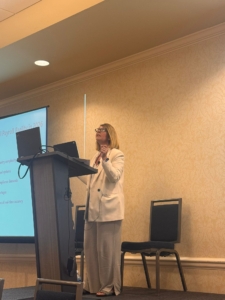
One of the most talked-about sessions of the week was Nick’s keynote, “The Payroll Pivot: Is The Fear Tax Making You Invisible?” I am obviously biased, but the reaction in the room spoke for itself.
Nick explored what he described as the payroll paradox: the idea that the very traits that make payroll professionals exceptional, caution, precision, accountability, can also hold them back from stepping into strategic influence. He also made the case that the cost of not acting, of staying invisible, of choosing caution over courage, compounds over time in ways most professionals never calculate. Drawing on personal stories, industry insight, and leadership coaching, he reframed payroll’s role in a way that clearly resonated. His line that payroll is the mechanism through which modern economies function got a visible reaction.
Rather than positioning AI as a threat, Nick encouraged payroll professionals to embrace their evolving role as the future ‘algorithmic conscience of work.’ And one of the session’s most memorable moments came when he reminded the audience: algorithms calculate, but people care.
That idea, balancing technology with humanity, became one of the defining themes of the entire Congress.
Keynotes That Landed
Nataly Kogan opened the week with a keynote on reinvention, growth, and navigating uncertainty.
For a profession that has spent decades being told to stay in its lane and process accurately, her message about adapting during disruption while staying connected to purpose felt particularly relevant.
Jason Dorsey delivered one of the standout sessions of the entire week on generational workforce dynamics. His research into how Gen Z approaches communication, flexibility, technology, and trust gave the room a lot to think about, particularly alongside the AI and earned wage access conversations happening elsewhere.
And Scott Bloom closed the week with a reminder that landed harder than you might expect from a session built around humour. His line that human interaction is becoming our most valuable resource felt like the right way to end a Congress that had spent five days talking about technology. Because despite everything, the week kept coming back to the same truth. Payroll is about people.
 The Podcast Booth
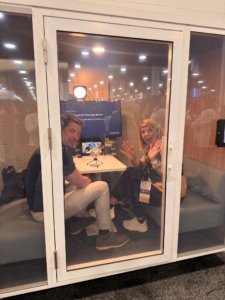
One of the highlights of the week for our team was hosting The Payroll Podcast booth in partnership with the PayTalk Podcast. Throughout Congress, the booth became a hub for conversations with payroll leaders, technology providers, and attendees discussing everything from their Congress experience to AI, leadership, talent, and the future of payroll. I even got the chance to interview Susan Baptista, PAYO’s Payroll Woman of the Year 2026. Those booth conversations were some of the most honest of the week, on and off camera. Away from the stage, people talked openly about what they are actually struggling with, what is working, what is not. It reminded me why the work we do at JGA Recruitment Group matters. Payroll professionals have extraordinary stories. They just do not always get asked to tell them.
And Then There Was the Fête
I cannot write about Payroll Congress without mentioning the fête. For anyone who has not been, it is the social event of the week, a chance for the community to come together away from the conference floor. And it delivered exactly what you would hope: a room full of people who spend their working lives managing precision, deadlines, and compliance, letting their guard down and enjoying each other’s company.
That balance between professionalism and personality is what makes payroll professionals unique. And Nashville, with Broadway on the doorstep, was the perfect backdrop for it. The conversations that started in sessions continued in bars and restaurants long after the day’s programme had ended. As a first timer, that was something that made Payroll Congress stand out. Not the scale of the event, but the warmth of the community. People were seeing my red sticker and deliberately coming over to welcome me, connect, and share tips and insights (and directions around the conference center!)
 What I Took Away
I went to Nashville expecting a great payroll conference. What I got was an understanding of why our community keep going back year after year.
Payroll professionals are no longer just being asked to run payroll accurately. They are being asked to lead transformation, influence strategy, navigate AI adoption, drive compliance confidence, and deliver operational resilience. All at the same time. The gap between what the profession is expected to deliver and what it is resourced and empowered to do is real.
And people are not pretending otherwise.
What I took away from Nashville is that this community is not waiting for permission. The energy, the ambition, the honesty in every session, every conversation, every late-night discussion on Broadway, told me this profession is ready for the shift. The conversations are bigger than they have ever been. The challenges are real. And the people leading the way are doing it with a combination of technical expertise, commercial thinking, and genuine care for the employees they serve.
If Payroll Congress 2026 proved anything, it is that payroll’s future will be driven not just by technology, but by the people leading it.
 One Last Thing
During Nick’s keynote, he said something that stuck with me long after the session ended. He talked about what he calls The Fear Tax, the hidden cost of the decisions we avoid, the conversations we do not start, and the opportunities we talk ourselves out of. His argument was that fear is rarely the dramatic, obvious kind. More often, it disguises itself as sensible caution. We tell ourselves it is not the right time, or we are not ready, or we will do it next year.
I nearly did that with Congress.
Before Nashville, I’ll admit, I had some nerves about going – it’s a whole week away from the desk. I am not a payroll professional. I was not sure if I would fit in. Every one of those reasons felt like wisdom at the time. Looking back, every one of them was fear wearing a sensible hat.
So, if you are reading this and wondering whether Payroll Congress is for you, whether you would know enough people, whether it is worth the trip, whether you would get enough out of it, I can tell you from experience: you would. The community is warmer than you expect. The conversations are more honest than you expect. And you will leave with more ideas, more connections, and more energy than you arrived with.
Do not let the Fear Tax cost you another year.
I am already looking forward to San Antonio in 2027.
Natalie Lloyd is Head of Brand & Partnerships at JGA Recruitment Group, specialist payroll and HCM recruiters operating across the UK, EMEA, and USA.